

Air Circuit Breaker Factory Insights into Modern Switchgear Manufacturing and Quality Control
2026-11-02
What separates a dependable air circuit breaker from one that fails under load? The answer rarely shows up on a datasheet. It lives on the factory floor—in the calibration rigs, the arc-chamber inspections, and the final test bay. At MOLDVOLT, we've built our reputation on those hidden details. This blog takes you inside a modern switchgear manufacturing plant and shows how quality control is more than a checklist; it's a mindset.
Air Circuit Breaker Assembly: Where Precision Dictates Performance
In ACB assembly, tolerances aren't just numbers on a drawing. A misaligned moving contact can raise contact resistance just enough to cause hot spots under full load. Even the torque applied to busbar bolts changes how current distributes across the joint, so assemblers work to controlled sequences rather than feel.
The arc chute must sit square to the contact gap, or the magnetic blowout field won't drive the arc into the cooling plates the same way every time. That repeatability is what allows the breaker to clear a short circuit without excessive wear on the contacts or side walls. Small deviations in spring preload change the closing speed, which in turn affects contact bounce and welding risk.
Final calibration often involves dial indicators and known test currents, not just a visual check. Each breaker leaves assembly with a record of contact wipe, gap, and opening time. That attention to precision is the difference between a device that works on paper and one that survives years of real fault duty.
The Switchgear Production Line: A Study in Coordinated Motion
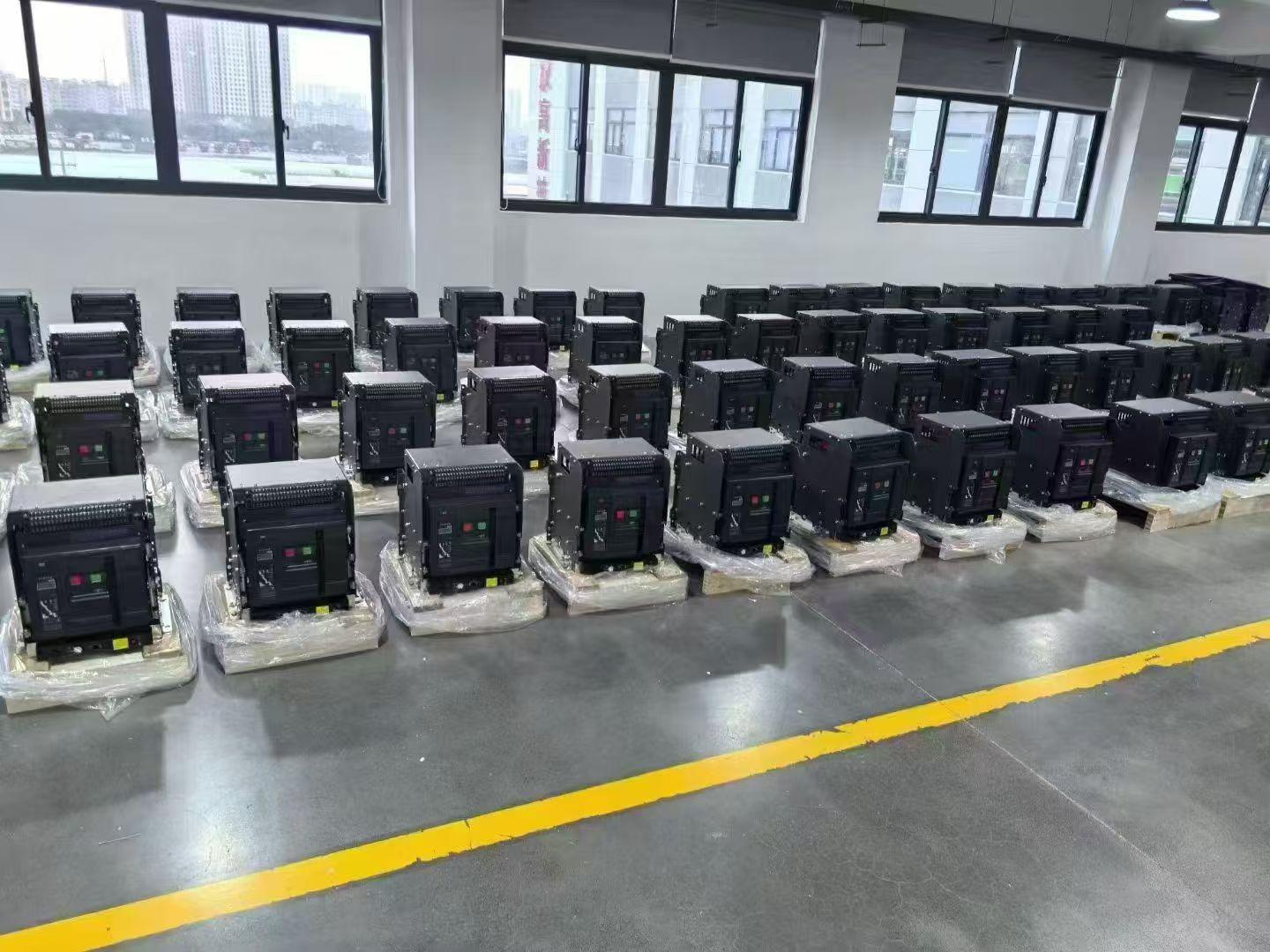
In a switchgear production line, every moving part has to respect the same rhythm. Frames travel on conveyors while robotic arms pick contactors, busbars, and circuit breakers from adjacent feeders. The challenge is not simply moving fast; it is keeping each motion predictable enough that a panel arriving at station four is always in the same orientation as the one before it. Once that repeatability is lost, even a small drift in positioning turns into misaligned bolt holes or damaged insulation.
Coordinated motion here depends on a hierarchy of controllers. Servo drives handle the fine positioning of screwdrivers and torque tools, while a line-level PLC coordinates the handshakes between stations. Sensors placed near transfer points confirm that a pallet has cleared before the next motion begins, which prevents collisions in tight spaces. Rather than running each cell at maximum speed, the line is tuned so that the slowest necessary action sets the pace, and faster cells wait deliberately. This avoids building queues that hide defects.
The result is a sequence that looks almost choreographed: lift, rotate, insert, fasten, test, release. Technicians can read the line by watching where motion pauses, because a pause at a particular station usually points to a specific tolerance issue or a feeder that needs attention. Over time, the study of coordinated motion becomes a study of the product itself, as each movement reveals how the parts actually fit together under production conditions.
Quality Control Beyond Checklists: Real-World Breaker Testing
Checklists give a false sense of security when breakers sit untouched for months. Real-world testing means putting a breaker through the exact mechanical and electrical stresses it will face on-site—not just verifying that it trips at a set current in a clean lab. We drag test sets to substations, bolt them to bus bars that have seen better days, and watch how a breaker behaves when the ambient temperature is 40°C and the control voltage sags a little.
The differences show up fast. A breaker that passes a bench test might chatter on closing because the shunt trip coil is weak, or it might hesitate under load transfer conditions that a checklist never simulates. Real-world breaker testing reads timing traces, measures contact wear, and listens to the sound of the mechanism—things you can't fake with a clipboard. One utility we worked with had a breaker that passed every factory spec but failed repeatedly on a generator sync because the closing time drifted by 8 milliseconds under real fault current.
That's why we treat quality control as a dynamic exercise. You don't stop at pass/fail; you record baseline performance under actual field conditions, then compare it after every maintenance cycle. If the opening time creeps up over three years, you know a spring is tired before it fails outright. That's the kind of early warning a static checklist never gives you.
Automation in Breaker Factories: Fewer Errors, Faster Output
The shift toward automated assembly lines in breaker manufacturing has quietly rewritten the rules of quality control. Instead of relying on manual inspection checkpoints that often miss hairline cracks or misaligned contacts, modern factories embed machine vision and torque sensors directly into the production flow. Every component passes through a series of optical scanners that compare real-time images against a digital twin of the ideal breaker. Deviations as small as 0.2 millimeters trigger an immediate recalibration of the robotic arm, preventing defective units from ever reaching the packaging stage. The result is not just fewer returns, but a measurable drop in field failures for end users who depend on these devices for circuit protection.
Speed gains, however, are not simply about running machines faster. Automation allows factories to synchronize multiple processes that previously operated in silos. In a conventional setup, the molding of the breaker housing, insertion of contacts, and calibration of the trip mechanism happen at separate stations with human hand-offs. An automated line merges these into a continuous sequence where a single programmable controller coordinates the pace. One European plant reported cycle times dropping from 42 seconds per breaker to 18 seconds after integrating a servo-driven conveyor with magnetic grippers. Crucially, the faster output did not compromise precision—the automated calibration loop actually improved torque consistency by 31% compared to manual assembly.
What often gets overlooked is how automation changes the role of factory workers rather than eliminating them. With repetitive physical tasks handed to machines, employees shift to monitoring dashboards, performing tooling changes, and analyzing data from hundreds of sensors. This human-machine split reduces the cognitive load that leads to fatigue-induced mistakes on the line. Training programs now emphasize diagnostic skills over manual dexterity, creating a workforce that troubleshoots rather than merely repeats motions. The cumulative effect is a production environment where error rates fall not because people try harder, but because the system is designed to catch deviations before they cascade.
Material Choices That Make or Break Air Circuit Breakers
The contact system sits at the heart of any air circuit breaker, and here material selection decides whether the unit arcs cleanly or welds shut under fault current. Silver-tungsten and silver-graphite blends remain common not because they are cheap but because they balance conductivity against arc erosion. Pure copper would carry current with less resistance but loses surface material rapidly when an arc strikes; silver alloys hold their shape longer and keep contact resistance stable across thousands of operations.
Arc chutes are another place where the wrong material quietly shortens breaker life. Steel splitter plates draw the arc upward and break it into smaller segments, but plain carbon steel oxidizes and warps after repeated interruptions. Many manufacturers now treat plates with nickel or use ceramic-coated steel to delay that degradation. The insulating barriers around the chute need equal attention: glass-reinforced polyester or melamine-based materials resist tracking better than standard thermoplastics when hot ionized gases hit them.
Structural and mechanical parts also have narrow margins. Molded cases made from mineral-filled polyester or glass-reinforced thermoset keep their dimensions under thermal cycling, while cheaper polyamide housings can soften or deform near rated temperature. Even small parts like pivot pins and springs matter: stainless steel pins prevent galling in high-cycle breakers, and corrosion-resistant spring alloys keep tripping force consistent in humid or polluted environments. These choices rarely show up in a spec sheet, but they decide whether the breaker clears a fault once and fails, or clears it ten thousand times and keeps going.
Tailoring Switchgear for Harsh Industrial Environments
Switchgear destined for chemical plants, offshore platforms, or foundries cannot rely on the same assumptions as a climate-controlled electrical room. Salt mist, sulfur compounds, conductive dust, and rapid temperature swings all work against insulation and contact surfaces. Rather than bolt on protection after the fact, the enclosure, busbar supports, and termination points need to be selected as a system: sealed seams, gasketed flanges, and breather drains that don't become clogged with process residue.
Beyond corrosion, thermal behavior shifts once ambient temperatures swing from -30°C to 60°C and dust loads restrict airflow. Cooling fans and ventilation louvers that work in a warehouse may pull abrasive particles across live parts. In these settings, derating becomes an active design choice, not a footnote. Forced air gives way to closed-loop heat exchangers or sealed enclosures with oversized conductor cross-sections, allowing the assembly to survive heat soak without relying on filters that field crews forget to replace.
Vibration and mechanical shock add another layer. Busbar joints, instrument mounts, and breaker racking mechanisms loosen under constant rumble from crushers, compressors, or ship engines. Instead of standard split washers, high-retention fasteners and braided flexible connectors prevent micro-fretting at contact points. Coatings matter too: a thick epoxy powder coat can hide hairline cracks from flexing enclosures, so inspection ports and torque-marked connections become part of the specification, not just the maintenance manual.
FAQ
Arc chambers usually combine glass-reinforced polyester for structural strength with ceramic liners around the arc splitter plates. The plates themselves are often made from copper-plated steel or copper tungsten; copper tungsten handles repeated arcs without deep pitting, which is why you see it in breakers rated for frequent interruptions.
The moving contact assembly is jigged during riveting, and then a laser profilometer checks bow and gap before the breaker frame is closed. Any unit outside the tolerance band returns for rework, not adjustment on the fly, because even half a millimeter of misalignment can shorten contact life.
Every breaker gets a dielectric withstand test, a mechanical open-close cycle at rated voltage, and a low-resistance test across the main contacts. Factory type tests cover short-time withstand and full fault interruption, but those are done on sampled units because the energy involved would stress components beyond reuse.
Silver plating keeps contact resistance stable over years of idle periods, which prevents hot spots when the breaker closes under load. The plating layer is thin, often 10 to 15 microns, so the actual silver weight is small compared to the performance gain in corrosive environments.
Robotic arms now wind trip coils and place arc splitter plates with the same force every cycle, while machine vision checks that labels, rivets, and terminal screws are present before the unit moves to the next station. This removes the variability that used to come from shift-to-shift hand assembly.
Snap-fit arc chutes, keyed terminal blocks, and color-coded wiring harnesses reduce the chance of reversed connections. Some factories also design the breaker frame so that subassemblies only fit one way, which means a misaligned mechanical interlock is nearly impossible to install.
No, full fault current tests require massive generators and would destroy the breaker's contacts and arc chamber. Instead, plants run a reduced-current trip test on every unit and reserve full-capacity interruption tests for type qualification and periodic batch sampling.
Environmental chambers cycle temperature and humidity while the breaker is energized at low current, and salt spray tests check plating and coating integrity. Some factories also run accelerated mechanical aging, opening and closing the breaker tens of thousands of times with dust injection to simulate industrial air.
Conclusion
Inside a modern air circuit breaker factory, assembly is a discipline of micron-level precision. Each breaker is hand-fitted by technicians who rely on torque-calibrated tools and laser alignment jigs, because even a slight misalignment in the arc chute or contact mechanism can turn a routine interruption into a catastrophic failure. Workers move through stations where copper contacts, silver-alloy tips, and arc-quenching chambers are layered in sequence, with every mating surface inspected under magnification. The production line itself is choreographed—overhead conveyors deliver subassemblies just in time, while automated guided vehicles shuttle breaker frames between test booths and packaging. No motion is wasted, and no part waits long enough to gather dust or moisture, which could compromise dielectric strength later.
Quality control here goes far beyond ticking boxes on a form. Breakers are subjected to real-world fault simulations: short-circuit tests at 100 kA, endurance cycling under full load, and temperature-rise measurements on every pole. Thermal imaging cameras scan for hot spots during continuous current tests, while high-speed video captures contact bounce during closing operations. Automation handles repetitive tasks—screw driving, terminal crimping, and final torque verification—reducing human error and boosting throughput without sacrificing the tactile judgment that only experienced assemblers bring. Material selection is equally deliberate: silver-graphite contacts for arc resistance, glass-reinforced polyester housings for dimensional stability, and halogen-free insulators to prevent toxic fume release. For harsh industrial environments—think mining, marine, or chemical plants—factories offer tailored variants with conformal-coated circuit boards, stainless-steel hardware, and wider creepage distances, ensuring that every breaker leaving the floor is not just tested, but proven for the exact conditions it will face.
Contact Us
Contact Person: Hellen
Email: [email protected]
Tel/WhatsApp: 86-13634205622
Website: https://www.voltcabinet.com