

Best Robotic Bending Solutions for Complex Sheet Metal Parts
2026-10-26
When sheet metal parts grow more complex, conventional bending struggles to keep pace—yet that’s precisely where precision matters most. Robotic bending is changing the game, and the best solutions now handle intricate geometries with repeatable accuracy that manual setups simply can’t match. From aerospace brackets to medical device housings, the shift toward automation is no longer optional for shops aiming to stay competitive. At the forefront of this evolution is HUNSONE, whose robotic bending systems are redefining what’s possible for complex sheet metal fabrication. In this post, we’ll explore the key capabilities, selection criteria, and real-world benefits that separate top-tier robotic bending solutions from the rest—so you can decide with confidence rather than guesswork.
Taming Complex Bends with Robotic Systems
Complex bends have long forced fabricators to accept trade-offs between repeatability and setup time. Robotic systems shift that balance by pairing six-axis arms with software that predicts springback before the first physical part is made. Tube wall thinning, wrinkle formation on the inside radius, and inconsistent clamp pressure stop being guesswork when the robot adjusts its path in near real time. Operators still define the target geometry, but the machine owns the corrections.
The real advantage shows up in families of parts rather than one-off runs. A robot can store bend recipes, re-order them for tool clearance, and move from a tight offset bend to a large sweep without parking for manual retooling. In practice, that means a small batch of asymmetric exhaust tubes takes minutes to reprogram, not hours. Error margins narrow because the arm returns to the same load point every cycle, even when material batches vary slightly.
Where fixed automation stalls is with multi-plane bends that require the tube to rotate while the bend head changes direction. A robotic cell handles this by coordinating wrist rotation, carriage feed, and pressure die travel as one motion. The result is smoother transitions, fewer witness marks, and less need for secondary straightening. It is not simply automation; it is giving complex geometry a repeatable physical memory.
Sensor-Driven Adjustments for Springback Control
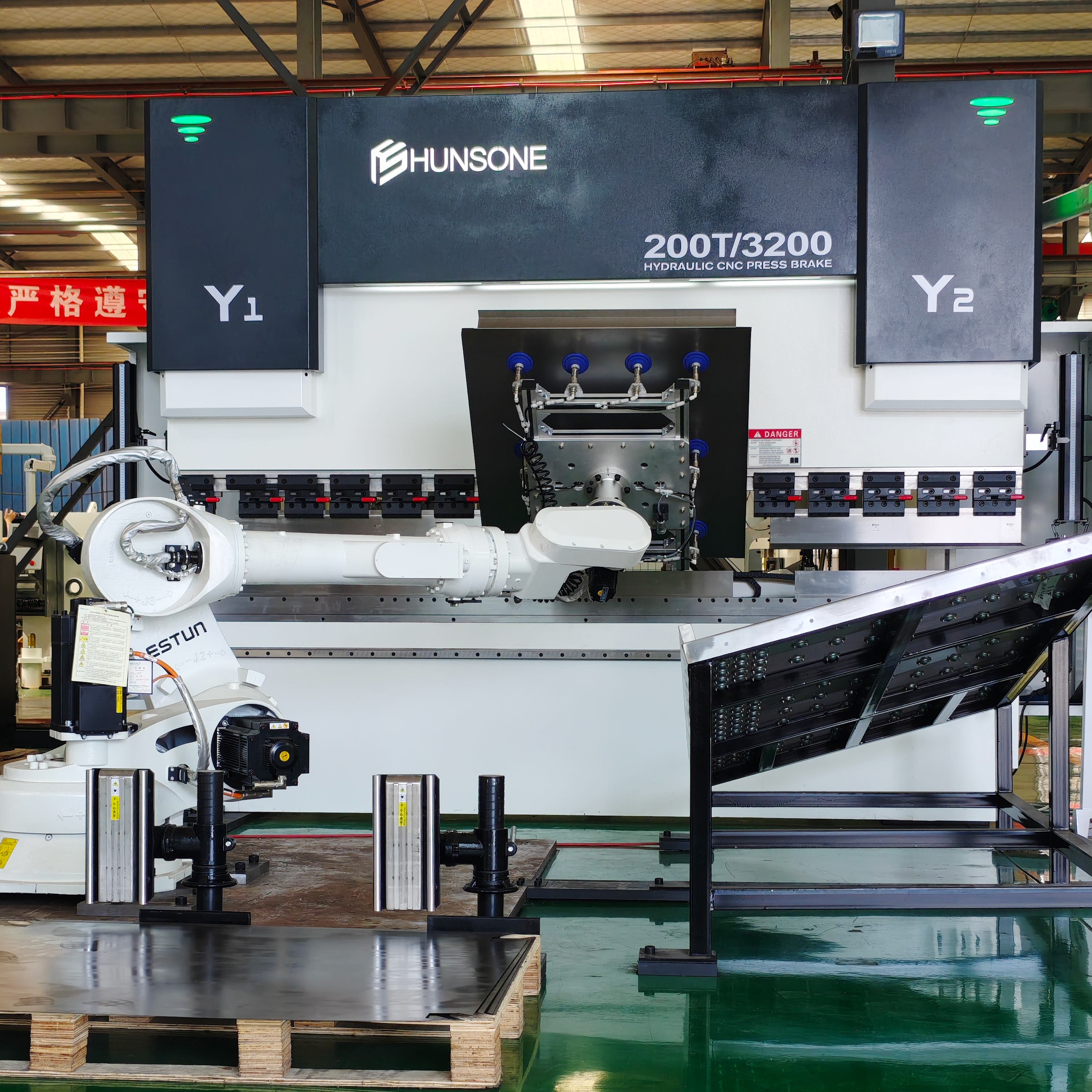
Every bending cycle leaves a slightly different elastic recovery, even when the press settings stay identical. Temperature drift in the tooling, batch-to-batch variation in sheet thickness, and work hardening all nudge the final angle away from the nominal target. Instead of relying on fixed compensation tables, sensor-driven adjustments close that loop at the source. Strain gauges near the punch and non-contact profile scanners capture the actual deformation path, while angle sensors on the part verify what happened after unloading. This stream of physical evidence lets the control system separate repeatable bias from random scatter, so the next stroke can be corrected before a bad part leaves the cell.
A common architecture places two measurement layers: during bending, tool-embedded load cells track the force signature; immediately after release, a laser profilometer or 2D vision system measures springback on the critical flange or channel. The controller compares these readings against a local reference model that accounts for the current coil's mechanical properties. When the measured springback exceeds a threshold, the punch depth or dwell time is modified on the fly. This is not a simple PID loop. Many shops use a recursive least-squares estimator to update the springback coefficient every few cycles, allowing the system to follow slow drift without overreacting to individual noisy measurements.
What separates this approach from older correction methods is the emphasis on capturing the unloading phase, not just the peak forming load. A press that monitors only maximum force will miss subtle changes in elastic modulus or residual stress that dominate springback. By adding a short post-bend measurement window and adjusting the next cycle's parameters, manufacturers can hold tighter angle tolerances across mixed batches of high-strength steel, aluminum, or advanced alloys. The result is fewer manual inspections, less rework, and a bending process that remains stable even when incoming material properties wander.
Offline Programming Shortcuts for Challenging Parts
On complex workpieces, experienced programmers rarely start from a blank tree. They pull in an existing project with similar geometry and swap the CAD model, keeping all the safe approach moves, collision envelopes, and tool orientations that still apply. This inheritance approach is faster than rebuilding every path. For leftover regions, feature-based auto recognition can generate drilling, contouring, and pocketing operations in one pass—then you just delete or adjust the handful of paths that don't suit the part.
Difficult reach and tight corners often eat up programming time because every retract and re-approach is handled manually. A better shortcut is to define forbidden zones around fixtures and clamped areas before any toolpath is created. The offline environment then automatically tilts the tool or robot away from those zones, proposing collision-free orientations for most moves. You can lock the acceptable sections and focus manual edits only on the remaining transitions, which is far less tedious than solving each axis limit one by one.
Another time-saver is to link toolpaths directly to CAD parameters. If a hole diameter or pocket depth changes, the related operations update without reselecting geometry, so revisions on challenging parts don't force a full reprogram. Pair that with a custom macro library for common routines like probing, tool changes, and safe home moves. Assign these to keyboard shortcuts or script buttons inside the offline software, and you eliminate many of the repetitive clicks that lead to mistakes on intricate components.
Tooling Choices for Thin and Thick Sheet Metal
When forming thin sheet, tool clearance is often the first thing that separates clean cuts from ragged edges. A punch-to-die gap of roughly 5 to 8 percent of material thickness works for most cold-rolled steel under 1 mm, but anything tighter risks galling on the punch flank. Backing plates and well-polished guide surfaces matter more here because thin stock follows the path of least resistance and can wrinkle if the tool isn't dead flat.
Thick sheet shifts the problem from distortion control to sheer load management. Clearances generally widen to 10 to 15 percent of material thickness so the fracture zones meet without secondary shear. Tool steels with higher toughness—think S7 or A2—replace the harder but more brittle grades often used for thin strip. Radii also grow: a sharp corner that trims 0.8 mm stock cleanly will simply chip or crack on 6 mm plate.
Die geometry aside, the supporting hardware diverges too. Thin-sheet setups lean on positive strippers, light die springs, and sometimes polyurethane pads to keep the blank from bowing. Thick-sheet work usually demands rigid knockouts, guided punches, and enough stroke length to eject a slug that can weigh several pounds. Matching these choices to material thickness prevents both edge burrs and premature tool failure.
Vision Guidance for Effortless Part Alignment
Instead of relying on precision fixtures or constant manual tweaks, vision guidance lets the system see where a part actually lands and correct for it on the fly. A camera or 3D sensor captures the current position, compares it to the expected location, and sends offset values straight to the robot or motion controller. That removes the need for perfectly staged parts and lets operators load pieces by hand or with simple automation without worrying about exact placement.
The real advantage appears when you stop treating alignment as a purely mechanical problem. Lighting changes, surface finishes, and background clutter can confuse older systems, but a well-tuned vision setup filters that noise and locks onto dependable edges or features. The result is a correction loop that runs in milliseconds, so even parts arriving at slight angles or shifted a few millimeters still get placed correctly the first time. It's less about forcing parts into a fixed position and more about letting the process adapt to what's actually there.
On the floor, that means fewer pauses to re-home or re-teach. Operators can swap part variants without touching the program, and the same guidance routine handles new batches with little to no setup. The alignment happens quietly in the background, so uptime stays high and the line keeps moving.
Multi-Stage Bending Cells for Consistent High-Mix Output
Shifting between short runs of wildly different parts used to mean accepting downtime, setup errors, or both. Multi-stage bending cells flip that trade-off. Instead of one press brake fighting through every bend sequence, the work flows through dedicated stations, each tuned to a narrow range of angles and material behaviors. Tooling stays in place, offsets are pre-set, and operators handle only one stage at a time. The result is high-mix production that holds first-part accuracy without constant recalibration.
Consistency in this setup comes from eliminating the cumulative drift that happens when a single machine is pushed across too many jobs. Each stage sees less variation, so springback compensation, clamping pressure, and bend sequencing become repeatable almost by default. Changeover is mostly moving the part to the next cell, not tearing down and re-zeroing tools. That keeps throughput steady even when every order in the queue is different from the last.
The real advantage shows up in mixed batches with tight tolerances. Rather than slowing down to protect quality, the line maintains pace because no single station becomes the bottleneck for adjustment. Scrap drops, first-piece inspection passes more often, and scheduling stops being a gamble on machine availability. Once the stage logic is dialed in, operators spend less time compensating and more time feeding the line.
FAQ
Complex parts often involve multiple bends, tight tolerances, and awkward blank handling. A robotic cell can reposition the part between bends without introducing the variation that manual repositioning causes, and it can manage flanges that would be difficult for an operator to hold safely. The result is consistent geometry across the entire run, even when the blank shape is far from a simple rectangle.
Offline programming lets engineers simulate the full bend sequence in a virtual environment before touching the physical cell. For intricate parts, this means collision checks between the robot, tooling, and part can be resolved ahead of time, and the optimal gripping points can be identified without wasting production hours on trial-and-error at the press brake.
During bending, material springback varies with grain direction, thickness, and local geometry. Angle correction systems measure the actual bend angle after forming and feed that data back to the robot and press brake controller, which then adjusts the next bend in real time. This closed-loop approach is especially valuable when a complex part has several bends that interact with each other.
Yes, if the cell is designed with quick-change grippers and automatic tool selection. In a high-mix environment, the robot can swap end-of-arm tooling in seconds and call up pre-validated programs for each part number. The key is to keep the operator out of the path for every changeover, so the bending process continues with minimal idle time.
Look for gripper designs that can hold the part without deforming thin sections, and check the robot's reach and payload against the largest blank after forming. It also helps to have software that models the actual formed shape between bends, because deep flanges can interfere with the robot arm or lower tooling if the sequence is not optimized.
Force sensors detect the resistance during each bend and compare it with the expected load for that material thickness and hardness. When the force deviates, the controller can adjust the bending depth or dwell time before the next stroke. This adaptive behavior reduces scrap when coils come from different suppliers or when heat treatment varies across a batch.
One mistake is underestimating the importance of blank flatness and edge quality; a robot may struggle to pick up wavy or burred blanks consistently. Another is using a single gripper for all part families, which often leads to dropped parts or marking. Finally, treating the robot cell as a standalone machine instead of integrating it with upstream cutting and downstream inspection creates bottlenecks that erase the expected efficiency gains.
Manual bending of large or oddly shaped parts often requires two operators and repeated lifting, which leads to fatigue and potential injuries. A robotic cell takes over the lifting and holding, keeping people away from the point of operation and reducing repetitive strain. The safety system also enforces consistent guarding and speed zones, which is difficult to achieve with manual workarounds.
Conclusion
Robotic bending has reshaped how fabricators approach complex sheet metal parts, turning what was once a trial-and-error nightmare into a repeatable, data-driven process. The core advantage lies in sensor-driven adjustments that actively compensate for springback, a persistent headache when forming high-strength or unevenly tempered materials. Instead of relying on operator intuition, robots measure the actual bend angle in real time and tweak force or position on the fly, so even a prototype with tricky geometry comes out right the first time. Offline programming adds another layer of control: complex part models are simulated before any metal is touched, identifying collision risks and optimizing bend sequences that would be nearly impossible to hand-code. Tooling choices also evolve with robotic cells, where quick-change grippers and adaptive dies let one system switch between thin aluminum and thick steel without a full teardown.
For high-mix production, multi-stage bending cells deliver consistency that standalone machines can't match. A robot can move a part through several bending stations—each pre-set for a specific angle or radius—while vision guidance handles part alignment automatically, eliminating the manual positioning that often leads to scrap. This is especially valuable for complex profiles with flanges, offsets, or asymmetrical folds, where even a millimeter of misalignment ruins the final shape. By pairing robust tooling strategies with real-time feedback, these robotic solutions reduce setup time, lower reject rates, and let a small team run what used to require multiple skilled operators. The result is a bending process that handles challenging parts with the same ease as simple brackets, all without constant human intervention.
Contact Us
Contact Person: James Chen
Email: [email protected]
Tel/WhatsApp: 86 13770803946
Website: https://www.hunsone.com/