

China Fan Coil Unit Selection Tips for Efficient Buildings
2026-10-26
Selecting the right fan coil unit for an efficient building in China isn't just about cooling capacity—it's about understanding regional climate demands, part-load behavior, and how the unit will integrate with the building's overall HVAC strategy. Many designers still rely on outdated rules of thumb that lead to oversized equipment, poor dehumidification, and wasted energy. In this guide, we share practical selection tips that go beyond typical catalog data, helping you deliver comfort and efficiency. And when you're ready to compare proven options, shairko offers a range of fan coil units engineered for exactly these challenges.
Rethinking Fan Coil Sizing for Partial-Load Realities in Chinese Offices
Conventional fan coil selection in Chinese office buildings leans heavily on peak cooling load calculations, a habit inherited from times when thermal comfort standards were less nuanced and envelope performance was far poorer. Yet the reality of daily operation tells a different story: for the majority of occupied hours, systems run at a fraction of their design capacity. Modern glazing, better insulation, and internal gains from equipment that fluctuates across the day mean that peak conditions are brief exceptions rather than the norm. When units are sized strictly for the worst-case scenario, they tend to cycle frequently at part load, driving up energy use, sacrificing humidity control, and forcing occupants to endure abrupt temperature swings as compressors or valves hunt for equilibrium.
A closer look at partial-load behavior reveals why oversized fan coils underperform in these settings. Most units regulate output by varying water flow or fan speed, but their efficiency curves are not linear; at low loads, the ratio of sensible to latent cooling often degrades, leaving spaces clammy or requiring reheating to maintain comfort. In Chinese offices, where occupancy density can swing widely between morning meetings and late-afternoon focus hours, a fixed-capacity mindset ignores the diversity of actual thermal demand. Engineers are beginning to embrace iterative sizing methods that use hourly simulation data rather than a single design day, allowing them to match coil capacity to the load duration curve. This shift means accepting a slight occasional shortfall at peak times in exchange for dramatically better performance across the thousands of part-load hours that define a typical year.
The practical consequences of rethinking fan coil sizing are tangible. Smaller coils, selected closer to the median load, reduce both first cost and the physical footprint of ceiling voids, while also cutting pumping and fan energy. Control sequences become more stable, and because units run longer at their sweet spot, dehumidification improves without overcooling. For Chinese office projects aiming at green building certifications or simply lower operating expenses, this approach turns the traditional sizing safety factor on its head: instead of adding margin everywhere, designers use detailed load profiles to place margin where it actually matters. The result is a system that feels less like a blunt instrument and more like a responsive layer tuned to how people really use the space.
Why South China Projects Need a Different Coil Material Mindset
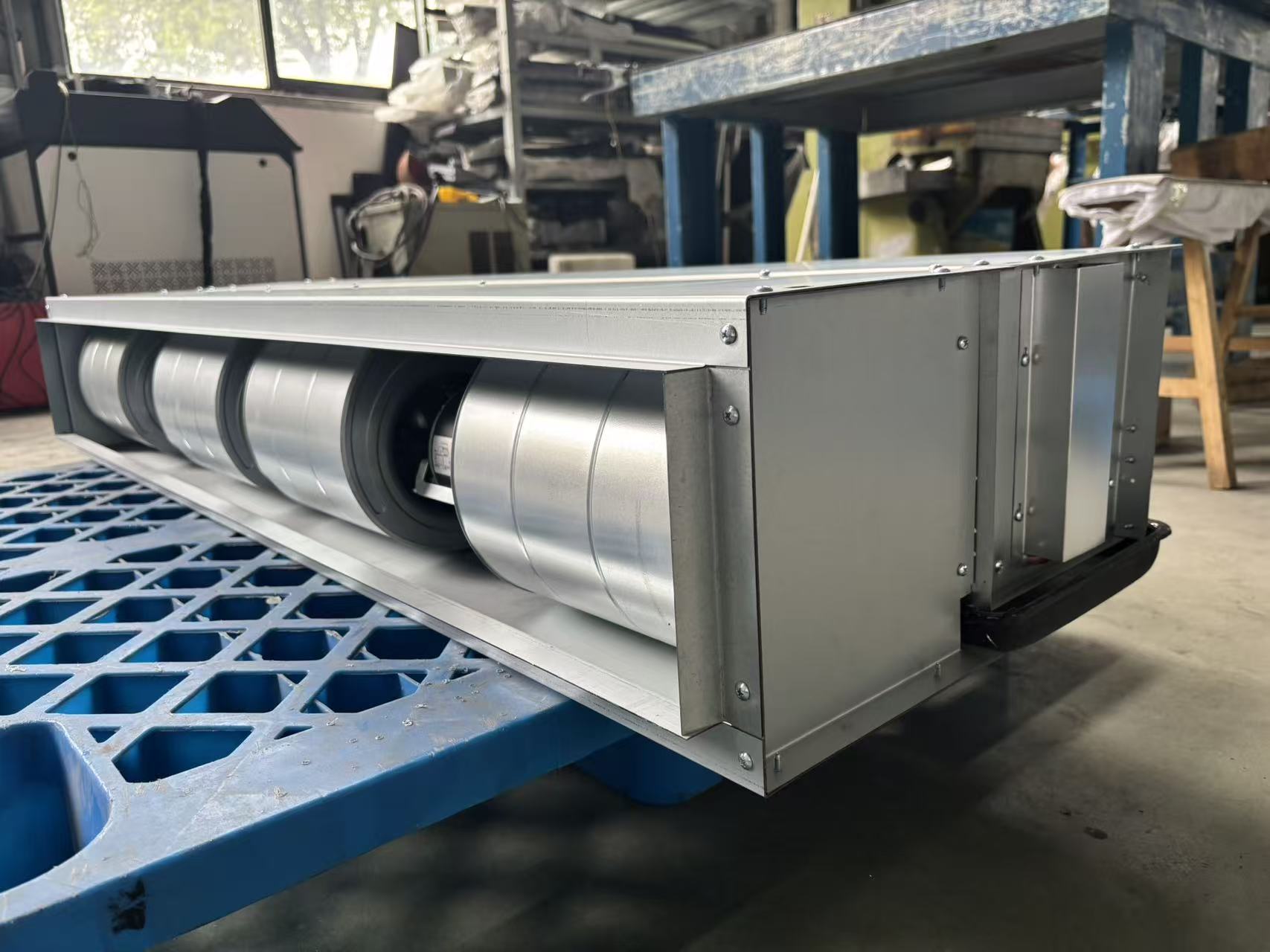
The humid, salt-laden air of the Pearl River Delta doesn't just corrode steel—it quietly rewrites the rules for every coil spec sheet brought in from drier northern provinces. A material choice that works flawlessly in a Shanghai high-rise can fail within two seasons in a Guangzhou industrial park, not because the grade is wrong on paper, but because the corrosion model never accounted for the combination of monsoon-driven moisture, airborne chlorides from coastal industry, and the acidic micro-dust common to dense manufacturing zones. South China doesn't simply need a better coil; it needs a recalibrated assumption about what “durable” actually means when the baseline environment is already aggressive by default.
Contractors and designers who treat coil selection as a commodity checklist often discover the hard way that local supply chains reward a different kind of literacy. In Foshan or Dongguan, the most respected material specialists rarely lead with tensile strength or surface finish alone. They talk instead about pitting resistance under cyclic condensation, about the creep of chloride ions through micro-defects in factory-applied coatings, and about how a marginally higher upfront cost for a marine-grade alloy can eliminate the hidden expense of premature replacement in a region where downtime is measured in lost export orders. What looks like over-specification from a distance is actually a rational hedge against a climate that punishes generic thinking.
Perhaps the deepest shift is cultural rather than technical. In northern projects, coil specification often follows a well-worn path of national standards and familiar supplier catalogs. South China, by contrast, has bred a generation of engineers who treat material data sheets as starting points, not conclusions. They test coupons on actual rooftops, track performance across wet and dry seasons, and build their own empirical libraries of what survives—and what doesn't—in the delta's unique microclimates. That mindset isn't just useful for corrosion resistance; it changes how teams approach thermal expansion in glass facades, galvanic coupling with aluminum frames, and even acoustical damping in typhoon-prone structures. The lesson is simple: if you're bringing a northern coil playbook to a southern build, you're already behind before the first sheet is unrolled.
Cutting Noise Complaints in Hotels Before They Reach the Guest Floor
Most hotel noise complaints never start at the guest room door—they begin with hard surfaces, thin walls, and unsealed gaps that amplify every footstep and conversation. Replacing hollow-core doors with solid-core versions, adding door bottom seals, and installing acoustic caulk around electrical outlets can reduce transmitted sound by half before a single guest checks in. For renovation projects, decoupling drywall from studs and laying down felt or cork underlayment beneath hallway carpeting are quieter, more permanent fixes than telling guests to keep it down.
Monitoring noise in real time gives staff a head start. Instead of waiting for a 2 a.m. phone call, place discreet sound sensors in corridors, elevator lobbies, and pool areas. These devices measure decibel spikes and send alerts to the house phone or security team when volume crosses a set threshold. The key is tuning thresholds to ignore normal movement—suitcase wheels, ice machines, distant laughter—while flagging door slams, shouting, or party-level music. Front desk staff can then knock, call, or text the offending room before neighboring guests wake up.
Finally, smart room assignment and simple policy tweaks cut problems off at the source. Group families and sports teams on lower floors or adjacent to stairwells, keep business travelers and light sleepers away from elevator banks and ice machines, and place long-stay guests at the end of corridors. Train housekeeping to use rubber-wheeled carts during quiet hours and ask the night audit team to walk each floor once after midnight. A five-minute hallway check often ends what would become a five-star complaint.
Decoding GB/T Performance Data Without the Marketing Filter
GB/T numbers are not marketing claims. They exist inside a tightly defined test environment, and every digit comes with a set of assumptions about temperature, voltage, load profile, and sample preparation. If you strip away those conditions, the same number can mean almost anything. Start by locating the exact clause in the standard that generated the figure — a 90% efficiency rating at 25°C says little about a 45°C rooftop installation.
Manufacturers often cherry-pick the most flattering GB/T metric while leaving the companion limits unmentioned. A battery might boast a high cycle life under GB/T 31484, but that figure assumes a narrow depth of discharge and a controlled charging routine. Without the full test matrix, you are comparing a laboratory ideal against your actual usage pattern. Ask for the test report, not the brochure summary, and look for footnotes that define sample size and preconditioning.
One practical trick is to treat GB/T data as a baseline for failure, not a promise of everyday performance. If a product only meets the minimum threshold in a standard, it means it passed a gate, not that it excels. Cross-check multiple GB/T metrics that are rarely advertised — standby power, noise at partial load, or capacity retention after 500 cycles — and you will see a more honest portrait of the product than any slogan can provide.
Matching Control Logic to Occupancy Patterns in Mixed-Use Towers
In mixed-use towers, the assumption that a single control strategy can serve all zones equally often leads to wasted energy and occupant discomfort. Office floors peak during weekday afternoons, while residential units see heavy activity in early mornings and evenings. Retail spaces fluctuate with foot traffic, and amenity floors operate on entirely different schedules. A static ventilation or cooling schedule tuned for an office block will overcool empty apartments at night or under-ventilate a crowded lobby during lunch hour. The first step toward smarter control is mapping actual occupancy curves per use type, not per floor plate.
Once those curves are known, control logic can be layered without overcomplicating the building automation system. For instance, corridor pressurization in the tower's residential section can follow a simple time-of-day profile, while open-plan office zones rely on CO2 and motion sensors to trim airflow during low-density periods. Retail units may use door counts or point-of-sale triggers to ramp up fresh air only when needed. The key is to assign a response hierarchy that respects both the lag time of mechanical systems and the diversity of occupant expectations—office workers tolerate slight temperature swings, but hotel guests do not.
Avoiding false precision matters as much as the logic itself. Over-instrumenting a floor with dozens of sensors creates maintenance burdens and can generate noisy data that forces the control system into constant hunting. A better approach is to cluster zones by actual usage patterns, then apply a modest set of rules: setback temperatures during known vacancy periods, demand-based ventilation in high-variability spaces, and manual override windows for after-hours tenants. By matching the control response to how people actually use the building—rather than a theoretical occupancy schedule—mixed-use towers can cut energy use by double digits without a single complaint about stuffiness or cold drafts.
Supply Chain Checks That Keep Counterfeit Coils Out of Your Spec
Counterfeit coils rarely come from a factory’s front door. They arrive through second-tier distributors, surplus auctions, or broker networks that mix reels from different lots. One practical check is to require a full chain-of-custody record for every purchase order—right down to the reel-level QR code and the original packing slip. If the seller can’t produce that in under 24 hours, it’s usually a sign the coils have been repackaged.
At the receiving dock, don’t stop at a visual once-over. Pull a random sample and run inductance at 100 kHz and 1 MHz; genuine coils stay within a tight band, while counterfeits drift because they use thinner wire or a different ferrite mix. Then do a quick DC resistance check against the datasheet’s minimum and maximum. A single reading outside that range is enough to quarantine the whole shipment.
Longer-term, keep a controlled reference sample from a verified production batch. When a new shipment arrives, place the suspect coil and the reference coil side by side under a stereo microscope—look at winding tension, solder joint shape, and core gap. Those small physical tells are hard for counterfeiters to copy, and they give your incoming inspector a fast go/no-go signal before any board-level testing.
FAQ
Latent capacity matters as much as total cooling capacity in Shanghai. Look for coils with a lower bypass factor and ensure the unit's sensible heat ratio matches the space's actual load profile. Drain pan design and coil fin spacing also need attention, because high humidity leads to more condensate and dust accumulation. A sloped, double-sloped, or antimicrobial drain pan can prevent water buildup. Check that the fan coil can operate at a lower entering chilled water temperature without sweating, especially if the building uses a dedicated outdoor air system for humidity control.
The current GB 55015 and related local standards set limits on specific fan power and require efficiency ratings for motors. This pushes consultants away from cheap AC fan coils toward EC or high-efficiency permanent split capacitor motors. The codes also encourage zoning and individual room control, which naturally fits fan coil systems. When selecting, verify that the unit's rated fan power per unit of airflow meets the mandatory limit, not just the nominal cooling capacity. Some provincial codes are stricter than national ones, so check the project location before finalizing the schedule.
Domestic manufacturers have closed the gap in coil quality and cabinet construction, but differences show up in sound data consistency and motor durability under voltage fluctuation. Imported units often publish third-party acoustic test results across multiple static pressures, while some local brands only provide free-field noise at zero static. For high-end projects, request sound power levels, not just sound pressure, and ask for the test standard. Check coil wall thickness and header material, because water quality in many Chinese cities can be aggressive. A thicker copper tube or cupronickel header may extend service life more than a brand name.
The rated cooling capacity is tied to a specific airflow, which requires overcoming the resistance of grilles, filters, and return ductwork. If the unit's available external static pressure is too low, actual airflow drops, and the coil cannot deliver its published capacity. Many selections fail because the engineer looks only at catalog cooling capacity without checking the fan curve at the required static. For spaces with high-efficiency filters or long return ducts, specify a unit with a higher static pressure option or install a remote booster. Also account for filter loading over time, which increases resistance.
Yes, oversized units cycle frequently at part load, causing temperature swings and poor humidity control. The coil cools the air quickly but does not run long enough to remove moisture, leaving the room clammy. Guests then lower the thermostat setpoint, which worsens the cycle. A better approach is to select the smallest unit that meets the peak sensible load and pair it with a digital thermostat that has adjustable deadband. In hotels with high occupancy variation, consider two-pipe changeover with variable speed fans or motorized valves that reduce water flow instead of shutting off completely.
Hard water and high dissolved solids in northern China accelerate scale formation inside the coil. Select coils with thicker wall tubing or specify a factory-applied internal coating. Access to the coil and blower without removing the entire cabinet is critical for regular chemical cleaning. Look for units with removable end panels or slide-out chassis. The condensate pan should be accessible for inspection and have a clear path for cleaning the drain line. If the building uses open cooling towers, consider strainers with smaller mesh and schedule automatic blowdown to protect the coils from particulate fouling.
A four-pipe system allows simultaneous heating and cooling in different zones, which is useful during swing seasons but adds piping cost and heat exchanger surface. For buildings with large core and perimeter loads, four-pipe avoids the inefficiency of reheating cooled air or cooling heated air. However, many Chinese office buildings with high internal gains can operate on a two-pipe changeover system if the switchover is automated and the building envelope is decent. The key is not the pipe count alone but how the control system manages water temperature reset and zone valve operation to avoid simultaneous heating and cooling energy waste.
Conclusion
Getting fan coil selection right in China means looking past nominal capacity and understanding how offices actually run. Most buildings spend very little time at peak load, yet units are routinely oversized, driving short cycling, poor dehumidification, and wasted fan energy. A more useful approach starts with part-load efficiency and turndown, not just rated cooling. In South China, high humidity and salt-laden coastal air make standard copper tube/aluminum fin coils vulnerable to corrosion, so coil material choices should reflect local exposure rather than a one-size-fits-all spec. At the same time, GB/T performance data needs careful reading: airflow, water-side resistance, and sound figures are often quoted at ideal conditions that won't exist on site. Requesting test points that match your actual entering water temperature and air conditions reveals whether the unit truly fits.
Noise complaints in hotels usually start long before guests check in—fan coil selection and duct layout set the acoustic baseline. Units with lower mid-frequency sound power and careful static pressure matching reduce the risk of transfer through partitions. In mixed-use towers, control logic should follow real occupancy patterns: offices need setback and start-stop alignment with lease hours, while residential floors may benefit from slow ramp and lower fan speeds during shoulder seasons. Finally, counterfeit coils are a persistent supply chain problem. Requiring serialized coils, third-party material testing, and traceability documentation from the factory helps keep substandard copper or thinner fin stock out of the specification.
Contact Us
Contact Person: Crystal
Email: [email protected]
Tel/WhatsApp: 8613524235353
Website: https://www.airkohvac.com