

China Split-Core Residual Current Transformer: Compact Solution for Retrofit Electrical Safety
2026-09-05
Retrofitting residual current protection into existing electrical systems has always been a disruptive, space-hungry task—until now. Xiasen’s split-core residual current transformer challenges that norm with a compact, clamp-on design that installs in minutes without disconnecting load cables. If you’ve ever postponed a safety upgrade because the downtime seemed too costly or the cabinet too cramped, this solution was made for your next project.
Why Split-Core CTs Make Retrofits Less Painful
Retrofitting current transformers into existing panels often means wrestling with rigid busbars, cramped wiring spaces, and the prospect of a full shutdown. Split-core CTs sidestep most of that drama because their two halves open and clamp around a conductor without breaking the circuit. You don't have to disconnect cables, slide anything over a live end, or rearrange decades-old terminations. The mechanical simplicity alone turns a multi-hour interruption into a quick, low-risk clamp-on job.
The real pain in retrofits usually comes from downtime scheduling and the labor needed to reroute conductors through solid-core units. Split-core models eliminate both. Since installation happens while the system stays energized, you avoid coordinating with production windows or losing revenue during peak hours. The clamp-on approach also means a single technician can often finish the measurement point in minutes, which keeps project costs predictable and avoids the domino effect of touching adjacent wiring just to make room.
Accuracy concerns used to push engineers toward solid-core designs, but modern split-core CTs have narrowed that gap considerably. With careful hinge alignment, precision-wound cores, and consistent clamping pressure, many split-core units now deliver metering-class performance that works for energy audits, load studies, or permanent submetering. That makes them a practical choice whenever you need reliable current data without the headache of a full shutdown or invasive electrical work.
Slim Enough for Crowded Electrical Panels
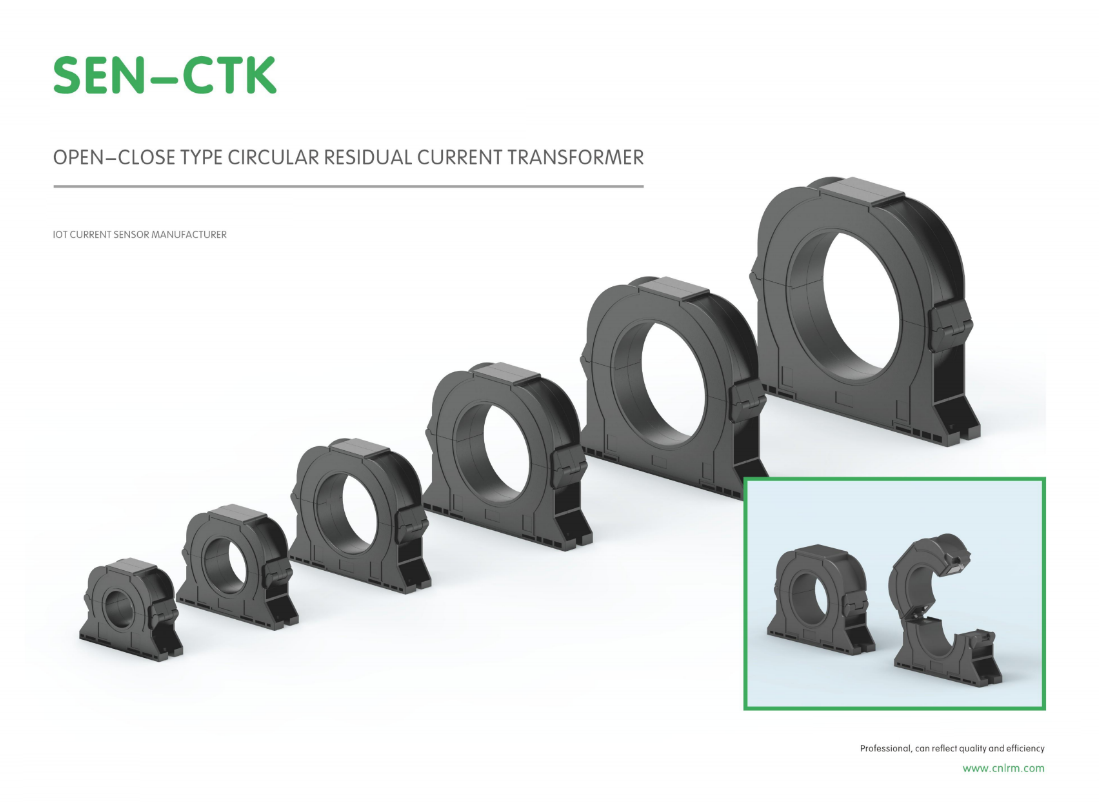
When every slot in the panel already looks spoken for, a bulky component can turn a simple install into a puzzle. This unit keeps its footprint deliberately narrow, so it slides into tight rows without nudging adjacent breakers or bending nearby conductors into awkward angles. You get the extra room you need without pulling wire after wire loose.
The low-profile housing also means less strain on the panel cover. Instead of fighting a deep body that presses against the door or forces you to leave a gap, the slim build lets the door close flush and keeps the interior looking orderly. Field techs can move faster because there’s no need to hunt for a wider knockout or shuffle load centers around.
Even in older panels where space was never generous, the compact shape helps avoid the usual trade-offs. You don’t have to sacrifice access to the bus bar or reroute branch circuits just to accommodate one more device. It fits like it was always part of the layout, leaving your hands free for the wiring that actually matters.
Clamp-On Installation Without Cutting Power
The clamp-on approach changes how you think about installing monitoring equipment. Instead of shutting down a circuit, you simply open the jaws, slide them around the conductor, and lock the clamp shut. This means no exposed wiring, no downtime, and no risk of disrupting whatever that line is powering. It's particularly useful in facilities that run 24/7 or where a brief outage could cause data loss or safety issues.
From a practical standpoint, the process is almost foolproof. The sensor's split-core design lets it wrap around an existing cable without any physical alteration. You just push the clamp open, position it so the conductor sits centered, then release. A good click tells you it's seated. There's no need to strip insulation or splice into the line—everything stays sealed and intact. It's the difference between modifying a live system and simply observing it.
This method also opens up scenarios you might otherwise avoid. Temporary measurements on a critical feeder, retrofitting an older panel without spare breakers, or adding sub-metering in a rented space—all become straightforward. Even with higher voltages, as long as the clamp is rated correctly and the installation is done by someone who knows what they're doing, the risk stays minimal. You get accurate readings without ever touching the copper.
Accuracy That Survives Real-World Electrical Noise
Electrical noise in real installations rarely follows the clean, textbook patterns you see in datasheets. Motors kick on, relays chatter, and nearby switching supplies inject broadband spikes straight into your measurement front end. Most precision systems fall apart under these conditions because their internal filtering assumes a stable, low-impedance ground and predictable noise spectra. The result is a reading that oscillates or drifts the moment a compressor or VFD starts up, forcing you to add external chokes, shielding, or software averaging just to get back to something usable.
The difference comes down to how the analog chain handles common-mode transients and high-frequency rectification at the input stage. You cannot simply average your way out of a 4 kV EFT burst if the first amplifier stage has already latched or shifted its offset. A front end that maintains linearity during fast-edged disturbances, combined with a converter that rejects out-of-band energy before it aliases into the signal path, keeps the final count stable. That is the kind of accuracy you notice when a production line runs for weeks without a single out-of-tolerance reading, even though the same power rail feeds three servo drives and an induction heater.
Validation under these conditions requires more than a sine wave and a benchtop supply. You need to inject burst transients, surge pulses, and conducted RF directly onto the supply and signal lines while monitoring the output code for glitches or baseline wander. When the reading stays within a few LSBs of the true value during a 2 kV common-mode spike, you know the accuracy is not just a lab number. It is built to survive the electrical chaos that exists wherever heavy equipment shares a panel with precision instrumentation.
Selecting the Right Residual Current Range
Matching the residual current setting to the actual installation rarely comes down to a single number. Start with the expected earth leakage from connected equipment—modern switch-mode power supplies and variable speed drives can produce continuous leakage well above the old rule-of-thumb values. If you ignore this and pick a 30 mA device purely out of habit, nuisance tripping becomes a regular headache, not an exception.
For circuits with multiple loads, add up the worst-case leakage rather than relying on nameplate ratings. A 300 mA or 500 mA residual current device often fits industrial feeders, while 30 mA remains the practical ceiling for personnel protection in most residential and commercial socket circuits. Where harmonic-rich loads are involved, consider a Type B or Type F device, because the residual current waveform may not be sinusoidal and can fool standard AC-type units.
Finally, think about discrimination. Upstream devices need a higher residual current setting and a short time delay to avoid taking out entire sections when a single branch trips. Plot the time-current curves of your intended devices instead of guessing—this small step prevents the classic mistake of having a 30 mA main switch upstream of a 30 mA final circuit.
Bringing Older Panels Up to Modern Safety Standards
Homes built before the 1980s often still have panels from brands like Federal Pacific or Zinsco. These units were once common but are now known for breakers that fail to trip under overload, leaving wiring vulnerable to overheating. A straightforward replacement of those breakers—or the entire panel if replacement parts are scarce—can bring the setup in line with what today’s electrical codes expect.
Beyond swapping out questionable hardware, bringing an older panel up to current standards usually means adding ground fault and arc fault protection where it didn’t exist before. This can involve installing dual-function breakers in key circuits, verifying that neutral and ground bus bars are properly separated in subpanels, and confirming that the enclosure itself is bonded correctly. Small upgrades like these do more than satisfy an inspection—they reduce the chance of a hidden fault turning into a fire.
A licensed electrician can check for less obvious problems such as corroded bus bars, undersized feeders, or signs of overheating around terminal screws. If the existing panel can’t physically accept modern breakers, a new enclosure with more space is often the only sensible route. While the cost can feel significant, the alternative is living with hardware that simply wasn’t designed to handle the loads or the fault protection expected today.
FAQ
Its split-core design lets you clamp it around existing conductors without disconnecting cables or shutting down the whole system, which saves time and avoids major rewiring.
The housing is small enough to fit into crowded enclosures where traditional CTs won't go, so you can add leakage protection even in tight meter boxes or distribution boards.
Yes, because the core opens and closes around the cable, installation can often be done without interrupting power, which is a big advantage in facilities that can't afford downtime.
It captures AC and pulsating DC residual currents, which covers the majority of earth fault scenarios in commercial and light industrial settings.
By monitoring leakage current and feeding that signal to a relay, it enables quick disconnection when a fault appears, reducing shock and fire risks in aging wiring systems.
It works with standard residual current relays that accept a secondary output, typically 1A or 5A or millivolt signal depending on the model, so integration is straightforward.
The split-core format means a technician can retrofit one in minutes without special tools, and the absence of moving parts keeps long-term maintenance minimal.
Many suppliers offer reliable production with short lead times and consistent test reports, though it's wise to request samples and verify certifications before bulk orders.
Conclusion
Retrofitting older electrical installations with residual current protection used to mean shutting down circuits, wrestling with rigid conductors, and often accepting that some panels simply lacked the space for another device. A split-core residual current transformer changes that calculation. Because the core opens and clamps around an existing conductor, there is no need to disconnect cables or interrupt supply during installation. The slim profile is a practical answer for crowded distribution boards where DIN rail space and wiring gutters are already full. In many retrofit situations, the alternative was either a costly shutdown or skipping protection altogether. A clamp-on current transformer removes that barrier while still giving the monitoring system a reliable signal for detecting ground faults.
Real installations are rarely electrically quiet. Variable speed drives, switching power supplies, and motor inrush can create high-frequency noise that confuses less robust residual current measurement. A well-designed split-core CT uses shielding and careful winding techniques to keep the output accurate even when the surrounding panel is noisy. Selecting the right residual current range matters as much as the physical fit. For personnel protection, a 30 mA trip threshold is common, while equipment or fire prevention applications often use 100 mA or 300 mA settings. Matching the transformer's range to the expected leakage current avoids nuisance tripping while still catching dangerous faults. This combination of compact mechanical design, non-invasive installation, and stable accuracy under real conditions is what makes these transformers a practical path for bringing older panels closer to modern electrical safety standards without a complete rebuild.
Contact Us
Contact Person: Liu Mengyang
Email: [email protected]
Tel/WhatsApp: 8618727589233
Website: https://www.cnlrm.com/en/