
Export Steel Pallet Supplier: Your Trusted Partner for Durable Shipping Solutions
2026-06-15
When your cargo crosses oceans, every detail counts—especially the platform it rests on. Weak pallets lead to damaged goods, costly delays, and frustrated customers. That’s exactly why global shippers turn to Lanyuda, an export steel pallet supplier built for the toughest supply chains. In this guide, we’ll break down how steel pallets outperform wood and plastic, and how partnering with Lanyuda can give your business a lasting shipping edge.
Engineered to Endure: Steel Pallets Built for Repeated Export Cycles
Most shipping pallets don’t survive their first overseas journey without splinters, warping, or outright collapse. That’s exactly why we engineered a steel alternative that doesn’t just endure the trip—it comes back for more. Each pallet is fabricated from heavy-gauge structural steel, fully welded at every joint to eliminate weak points that bolt-together designs often suffer from. A hot-dip galvanized finish fends off corrosion from salt spray, humidity, and rain, so they’re still solid after months in a container and repeated washdowns.
We know that export cycles chew through ordinary pallets fast, which is where these truly shine. Their uniform dimensions and forklift-friendly runners mean seamless handling across different supply chain hubs, even when floor space is tight. Over time, the math is simple: a one-time purchase that handles hundreds of round trips beats constantly ordering single-use wood or plastic replacements—and you eliminate the risk of product loss from a broken pallet mid-transit.
Beyond brute strength, there’s a hygiene advantage that matters for cross-border trade. Steel doesn’t absorb moisture, oils, or solvents, so it stays clean and won’t harbor bacteria or pests. That’s a big deal when you’re shipping goods subject to ISPM 15 regulations—no heat treatment or fumigation certificates needed. It’s a pallet built for logistics managers who are tired of workarounds and want a system that simply works, load after load.
Your Cargo, Your Way: Bespoke Steel Pallet Designs
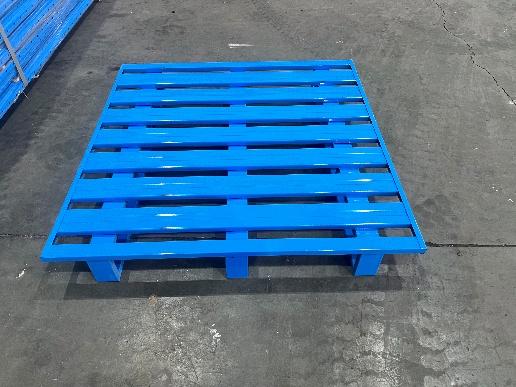
Every shipment carries its own set of demands. That’s why off-the-shelf pallets rarely fit the bill. Our team works from the ground up—mapping out your load’s weight distribution, the quirks of your storage racks, and even the forklift access points—to shape steel into a pallet that behaves more like a trusted tool than a temporary platform.
Steel’s resilience isn’t just about brute strength. In cold storage, it stands up to thermal shock without splintering. When humidity climbs, there’s no swelling or rot. And for those heavy industrial parts that chew through timber, a bespoke steel pallet simply keeps going, often outlasting the machinery it supports.
Design freedom means we can add lock-in brackets for fragile glass, nesting feet to save warehouse floor space, or even integrate a tilting mechanism for awkwardly shaped components. Each feature is a direct answer to a real-world headache, not an off-the-menu trend.
Global Logistics Without the Worry: Seamless Cross-Border Compliance
Navigating the maze of international shipping regulations can feel like a full-time job—one where the rules change without notice. Each border crossing brings its own set of customs codes, duty calculations, and paperwork demands that can easily trip up even seasoned logistics teams. Instead of wrestling with these complexities, imagine a system that quietly handles compliance behind the scenes, adapting to new mandates before they become headaches. It’s about building an infrastructure where every shipment is pre-screened against the latest tariff schedules and trade agreements, so you never have to pause operations to decipher a cryptic customs notice.
The real magic happens when technology and on-the-ground expertise merge into a single workflow. Automation flags potential issues while local specialists step in to smooth over nuances that algorithms alone would miss—think of a shipment rerouted just in time because a country suddenly tightened its inspection protocols. This blend keeps goods moving without the panic of last-minute holds or unexpected fees, turning cross-border delivery into a predictable rhythm rather than a gamble. It’s not just about avoiding fines; it’s about reclaiming the mental bandwidth to focus on growth instead of firefighting.
Ultimately, the goal is to make compliance feel invisible. When a package lands at a customer’s doorstep across the globe, the story behind it shouldn’t include frantic calls to brokers or lost sleep over missing documents. By embedding regulatory checks into every step—from origin to final mile—the process becomes so seamless that you might forget borders exist at all. That’s the kind of reliability that transforms logistics from a necessary cost into a quiet competitive advantage.
Heavy Loads? No Problem: Unmatched Weight-Bearing Strength
When you’re dealing with serious weight, the last thing you need is equipment that buckles under pressure. This gear is engineered with a reinforced core that laughs at limits most products treat as benchmarks. The frame integrates high-tensile alloys and strategic cross-bracing, so whether you’re stacking pallets or anchoring a structure, the load distribution stays rock-solid. It’s not just about static weight either—sudden shifts and dynamic force are absorbed without that nerve-wracking groan of straining metal.
What really sets it apart is the testing protocol. Instead of lab-perfect scenarios, we push these units through real-world abuse cycles: uneven surfaces, repeated impact loads, and long-duration stress tests that mimic years of service. The result is a weight-bearing capacity that consistently exceeds its rating by a comfortable margin, giving you that quiet confidence when things get stacked high. No skimping on the safety factor means no surprises when you’re maxing out the spec sheet.
On job sites where efficiency and muscle matter, this strength translates directly into fewer units needed per project and less downtime from failures. It’s the kind of overbuilt reliability that veteran crews appreciate—the stuff that simply doesn’t quit when the going gets heavy. That’s peace of mind you can measure in tons.
From Warehouse to Dock: Streamlined Handling & Stackability
Moving goods from the warehouse floor to the loading dock often becomes a maze of wasted motion. We’ve found that when products are designed to stack cleanly and handle smoothly, that path shortens on its own. Uniform base dimensions and interlocking profiles let warehousing crews double-stack pallets without second-guessing stability. The result is fewer trips, less lift-truck idling, and a natural rhythm that keeps inventory flowing instead of bunching up at choke points.
Stackability isn’t just about saving vertical space—it’s about making every lift count. Our containers lock into place with a subtle taper that prevents shifting during transport, yet release easily when it’s time to break down a load. Combine that with molded hand grips and beveled edges that guide a dolly fork, and you get handling that feels almost intuitive. Dock teams move faster, with less strain, because the packaging itself does part of the work.
A Greener Supply Chain: The Long-Term Value of Reusable Steel
Switching to reusable steel in logistics and packaging transforms how businesses approach sustainability without sacrificing performance. Traditional single-use materials may seem cheaper at first glance, but they mask hidden costs in waste disposal, resource depletion, and environmental penalties. Reusable steel containers, racks, and pallets can circulate for decades, slashing the need for continuous raw material extraction. This shift not only lowers a company’s carbon footprint but also builds resilience against volatile commodity markets. When a supply chain runs on durable, recyclable assets, it becomes less dependent on disposable alternatives that strain both budgets and ecosystems.
The long-term financial logic is compelling once you factor in total lifecycle costs. Steel’s strength means fewer replacements and repairs, and at the end of its service life, the material retains high scrap value, often recovering a significant portion of the initial investment. Compare this to plastic or wood counterparts that deteriorate quickly and end up in landfills with no residual worth. Warehouses and distribution centers using reusable steel systems also report marked drops in packaging waste fees and smoother handling due to standardized, precision-engineered designs. Over time, these efficiencies compound, turning a green initiative into a genuine competitive edge.
Beyond direct savings, embracing reusable steel sends a clear message to partners and consumers about a company’s commitment to circular principles. It aligns with tightening regulations on industrial waste and opens doors to clients seeking transparent, low-impact sourcing. As industries worldwide grapple with emissions targets, the ability to document the reduced material throughput becomes a powerful differentiator. Moving from a linear take-make-dispose model to a loop where steel is continuously reused redefines supply chain responsibility—not as a constraint, but as a strategy for lasting value creation.
FAQ
Steel pallets handle heavier loads, resist moisture and pests, and won’t splinter or warp. They meet international phytosanitary standards without extra treatment, which simplifies cross-border logistics.
Absolutely. We work with your specs to adjust size, load capacity, and even add features like anti-slip surfaces or fork guides. Just share your needs and we’ll tailor a solution.
We use high-strength steel and robotic welding for consistent joints. Each batch goes through load testing and surface coating checks to prevent rust and structural fatigue over time.
Our pallets carry ISO 9001 and regional safety marks. These prove compliance with global frameworks, reducing inspection delays and giving your clients confidence in the product’s reliability.
We serve sectors like automotive, heavy machinery, chemicals, and cold storage. Any industry that values clean, fire-safe, and stackable transport tends to switch to our pallets.
We keep raw materials in stock and run flexible production shifts. For orders over 500 units, we can prioritize and often ship within two weeks, coordinating directly with your freight forwarder.
Steel is 100% recyclable, and we optimize nesting to cut scrap. Our facility also reuses water and invests in energy-efficient machinery to lower the carbon footprint per pallet.
Conclusion
When it comes to international shipping, reliability isn't just a feature—it's the entire foundation. As a dedicated export steel pallet supplier, we ensure every pallet is engineered to endure the relentless demands of repeated export cycles. No matter how rough the transit or how heavy the load, our steel pallets deliver unmatched weight-bearing strength that keeps your cargo secure from warehouse to dock. But strength alone isn't enough. We also provide fully bespoke designs, letting you shape the pallet to your product rather than forcing your product to fit a standard pallet. This blend of brute resilience and tailored precision means your shipments aren't just protected—they're optimized.
Beyond the physical durability, we tackle the hidden headaches of global logistics. Our steel pallets meet seamless cross-border compliance standards, eliminating phytosanitary concerns and customs snags that so often plague wooden alternatives. Their streamlined handling and superior stackability save valuable time and space in tight container configurations. And while they start as a premium solution, their true value emerges over years of reuse—a greener supply chain built on longevity rather than disposability. We don't just sell pallets; we forge partnerships that make your shipping more predictable, efficient, and ultimately more profitable, one durable steel deck at a time.
Contact Us
Contact Person: Johnny
Email: [email protected]
Tel/WhatsApp: +86 18151010686
Website: https://lydstorage.com